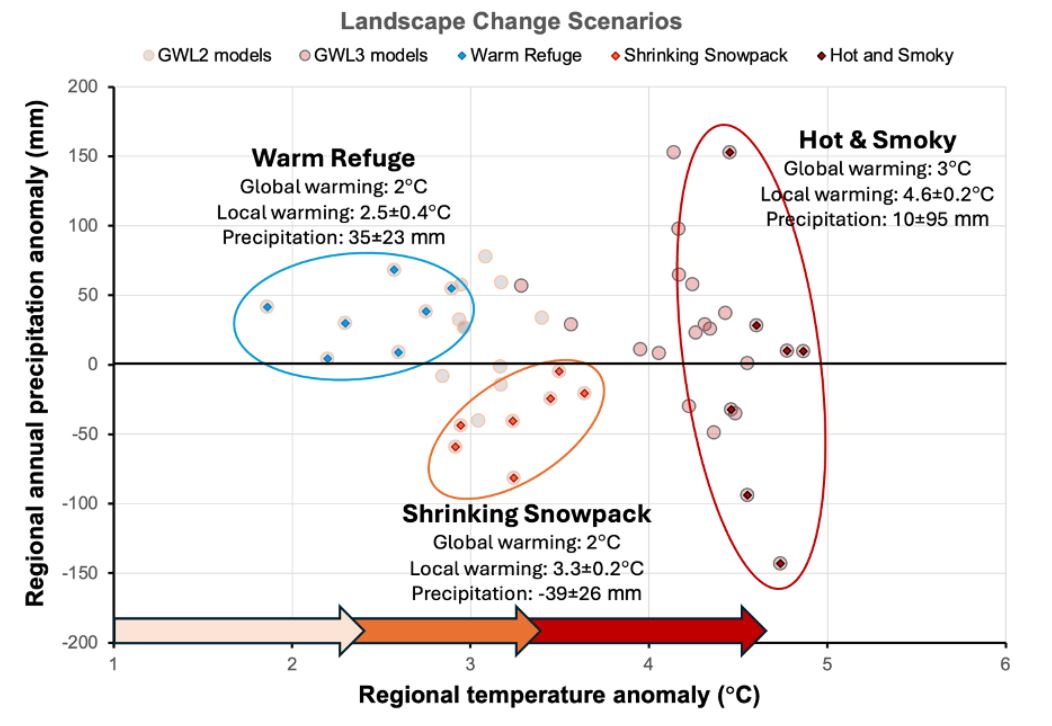
Narratives can support sense-making with science ideas and data by grounding abstract patterns in lived experience, place, and perspective. Rather than asking learners to immediately analyze or explain data, narratives create space to wonder, compare, and reason, while also inviting curiosity.
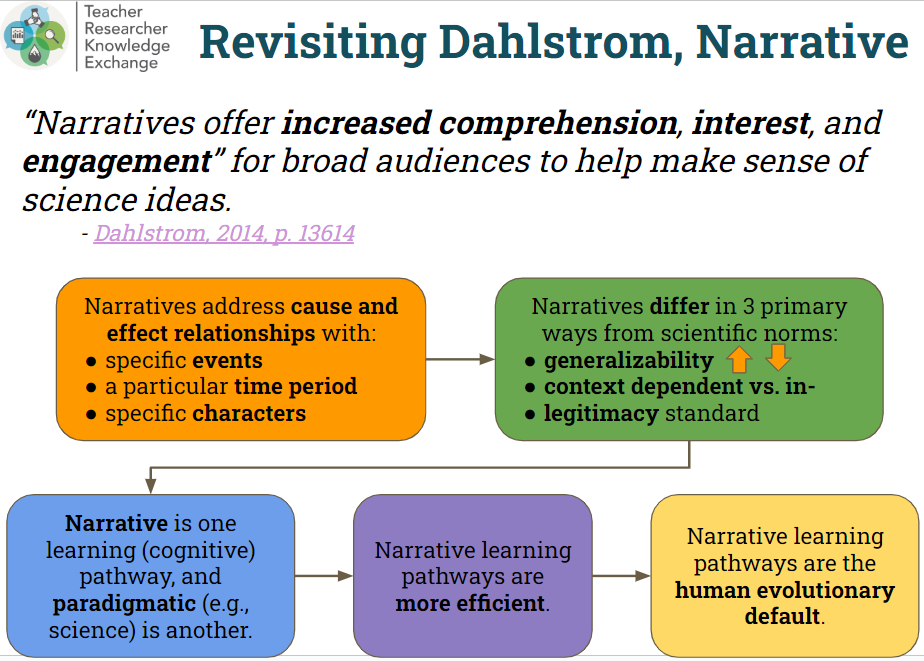
During our January 20th, 2026 Virtual Session, Dr. Mary Keller helped us explore how narratives can function as a learning and communication tool in science contexts. Mary synthesized ideas from Dahlstrom (2014), Howe (2002), Whyte (2018), and her own narrative practice to relay several key elements of effective, data-informed narratives:
- Use positive and accessible framing
- Provide access points to lived experiences and data
- Ground stories in cause and effect, connected to a specific event, place, and characters (human or non-human)
- Connect science to Indigenous and non-Indigenous memories, using place-based tools such as the Native-lands.ca map or Indigenous place names (Howe, 2002)
- Consider how relationships among people, communities, and ecosystems are shaped by society, inviting questions about ecological connectedness and fairness (Whyte, 2018)
- Use near-term future scenarios (e.g., the next decade or two)
- Incorporate multimedia elements (e.g., photos, videos, quotes, data visuals)
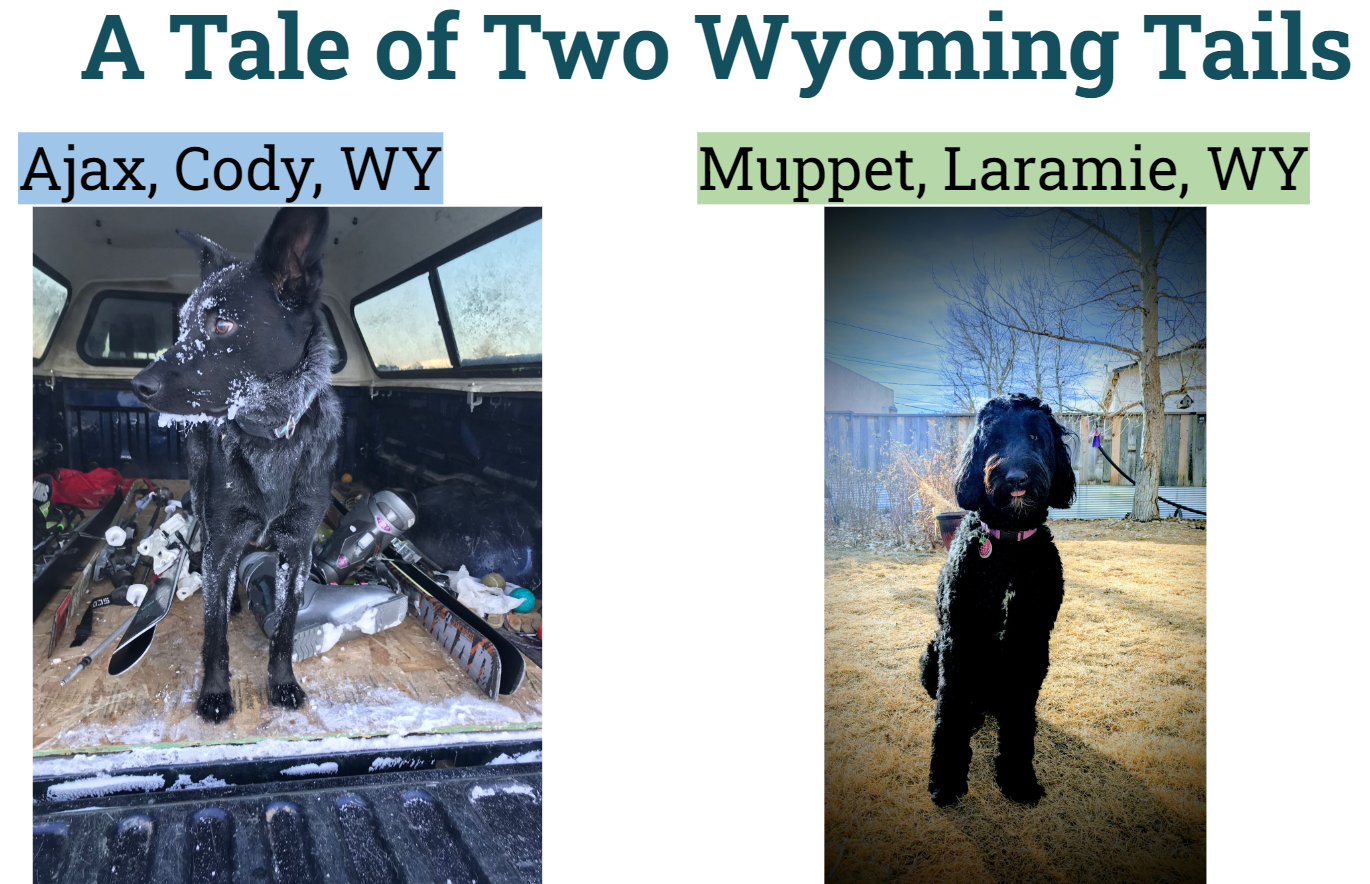
Using these elements, Mary shared an example narrative, A Tale of Two Wyoming Tails, told from the perspective of two dogs seeking the ideal location for skijoring with their people. Following Mary’s story, one participant asked two questions that helped surface why narrative can be such a powerful sense-making tool:
- "What is it about humans that makes us connect so strongly to characters?"
- "Why did Mary choose to tell the story from a dog’s point of view?"
First, Mary explained that by “setting [a narrative] in another place, another time, or from the perspective of another animal, what you create is the opportunity for what a narrative theorist would call transportation. And transportation is pleasurable. We like to go and travel into the imagination, and it’s an effective place for looking at something sideways… If you think about the Greeks and their theater, if you were in Athens, the play is more than likely going to be set in Thebes, or set in Sparta, or set somewhere else, because you can look more closely at the tragedies and comedies of a human if your brain got to travel away from you. And so, harnessing some of that in narrative is just a great way to work with human nature.”
Mary also explained: “I chose a dog [as the point of view of my narrative] because [skijoring is] really fun and it’s one of my landmark activities. And so, when I think of the holidays, I think of those kinds of trips we’ve done in the past. So I decided to work with what I know.” She added that, following the work of Lakota scholar Craig Howe, using dogs allowed her to include multimedia and provide a non-human perspective to support the narrative.
For those interested in trying to incorporate narratives into instruction, you can explore the full progression and example narratives created by other participants during the session:
- Using Narrative to Support Sense-Making with Data (Full progression)
- Example Narratives with WY-Adapt Data
References
Dahlstrom, M. F. (2014). Using narratives and storytelling to communicate science with nonexpert audiences. Proceedings of the National Academy of Sciences - PNAS, 111(Supplement 4), 13614–13620. https://doi.org/10.1073/pnas.1320645111
Howe, Craig. (2002). Keep your thoughts above the trees: Ideas on developing and presenting tribal histories. In N. Shoemaker (Eds.), Clearing a path: Theorizing the past in Native American studies (pp. 161-180). Routledge.
Howe, LeAnne. (2002). "The Story of America: A Tribalography." In Clearing a Path: Theorizing the Past in Native American Studies, edited by Nancy Shoemaker, 29–50. New York, Abingdon: Routledge.
Whyte, K. (2018). Critical Investigations of Resilience: A Brief Introduction to Indigenous Environmental Studies & Sciences. Daedalus (Cambridge, Mass.), 147(2), 136–147. https://doi.org/10.1162/DAED_a_00497